
Behind the Post with Carol (00:40)
"Hi there, it's Carol. Before you dive into today's post, I want to share a quick thought. I was in a coffee shop the other day waiting for a colleague and saw someone struggling with AI. I could tell because she had ChatGPT open and she had a really confused look on her face and she let out a huge sigh. It reminded me so much of how I felt when I first started. If you've ever felt like you're falling behind, or that AI is just 'too much,' this post is for you. We're going to talk about why you're actually the one in the driver's seat. Grab a coffee, read on, and let's look at the roadmap together."
From 'Deer in Headlights' to Prompting Pro: Why You Aren't Late to the AI Party
I recognized that look that I described in the audio of the woman in the coffee shop who had the huge sigh. I've felt that familiar sting. Perhaps you have too. The "AI FOMO." It's a nagging feeling that the world moved ahead while we were just trying to get through our emails. Here is the secret nobody tells you: AI is just like a bicycle you haven't sat on yet. You can ride it without a computer science degree. You simply need to know where you want to go.
Addressing Tech-Shame
That heavy sigh in the coffee shop stems from a feeling that our identities are at stake. For years, the world has equated success with being "tech-savvy." Remember when companies stopped putting user manuals in with new products? That was a shift! Now, when a new tool arrives without a manual, the confusion that happens next feels like an expiration date on our skills.
This "overcoming AI overwhelm" phase is the biggest hurdle. We often hesitate to ask questions because we fear they sound basic. However, using a GPS to find a new restaurant is a sign of efficiency. Choosing to use the best tools available is a leadership skill. You are giving yourself permission to be a beginner again while you master a new way to navigate.
The GPS vs. The Driver
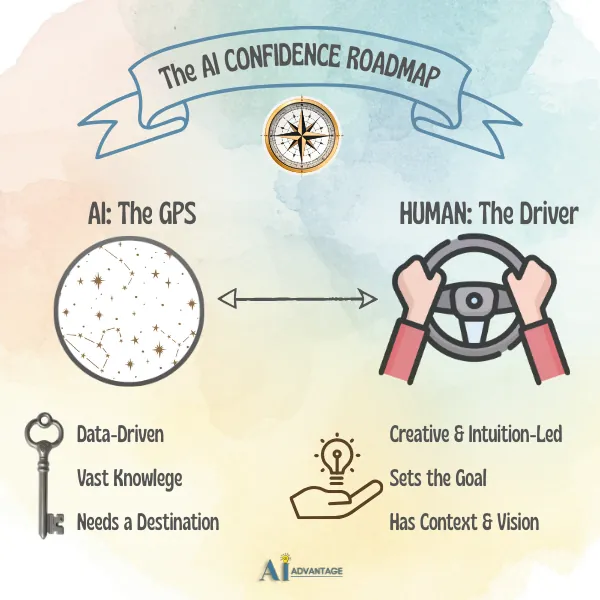
If you are looking for a human-centered AI strategy, start by changing how you view the tool. Using AI is like having a high-end GPS. It knows every road, alleyway, and shortcut in the world. It remains clueless about where you actually want to go for dinner.
The car sits in the driveway until you pick a destination. You are the driver. The AI is the most expensive map ever built. This shift in mindset is essential for building AI confidence. You are being handed a navigation system for your own creativity.
Setting Your Coordinates
To understand how to start using AI for beginners, you can set aside the need to code. You simply need to provide the "Destination." Here are 3 simple steps to start your first "drive":
Step 1: Define the Destination (The Goal)
Just like a GPS needs a specific address, AI needs a defined outcome. Vague requests lead to vague results.
- Instead of: "Help me with my business."
- Try: "Help me write a 3-sentence email to a client who is late on a payment." or "Give me an overview of the best places to visit during the month of July in Scandinavia."
Step 2: Choose the Route (The Persona)
Decide if you want the "scenic route" or the "fastest commute." In the world of AI prompts for non-technical users, this is where you define the vibe. Tell the AI how to speak by adding a simple instruction:
- "Keep the tone polite but firm, like a professional friend."
- "Stay concise without adding a lot of technical jargon or acronyms."
Step 3: Check the Map (The Human Review)
We've all seen a GPS try to send us down a one-way street. You are the one behind the wheel, which means you have the final say. Always read the AI's draft and tweak the words that don't sound like "you." It doesn't take long to do this, but in the end it can save a lot of heartache. Nothing worse than having your own creative thoughts labeled as "oh, AI must have written this!" (By the way, AI helped me brainstorm this topic, but did not write it for me.)
What's Next
Your mindset is the engine, and soon we will discuss the different vehicles you can drive. In the coming weeks we'll expand our focus and look at specific tools that fit your unique needs.
Think of the current AI landscape as a huge fleet of equipment. Some tools are built for high-speed writing. Others are designed for deep-sea research and fact-finding. Matching the right tool to your specific task is the hallmark of a smart navigator. We will break down exactly how to choose your "best-fit" tool in an upcoming post so you can move forward with a clear view of the road ahead.
The Check Your Coordinates Question
Before you close this tab, I have a quick check-in for you. Are you currently approaching AI as a passenger waiting for instructions, or are you ready to grab the wheel as the driver?
I'd love to hear your "destination" for this week. Whether it is finally clearing out that pile of emails or drafting a project plan, tell me one task you want to navigate with AI in the comments below.
Stuck in a cul-de-sac? If your AI output feels like it's going in circles, join our next "COFFEE + Carol" mentoring session. We will help you recalibrate your coordinates and get your workflow back on the main road. Look at all the options at aiadvantage.cc

Carol Chenot
AI Educator & Mentor
Making AI Accessible, Understandable & Useful







Share Your Thoughts
Have a question or want to share your experience? I'd love to hear from you.