

The Day My Assistant Became a Mind-Reader
That flickering monitor, a thick three-ring binder, and a strong feeling of defeat. I think we’ve all been there. Staring at a blinking cursor, wishing the computer could just understand what we need without a twenty-minute explanation?
Early on in my AI journey, I hired a “virtual assistant” (let’s call her Chatty G). I asked her to “write a follow-up email to a client.” The result? It was fine, but it wasn’t me. It was generic, stiff, and honestly, a little bit boring. It felt like I was working for the technology instead of the technology working for me.
Then I changed one thing. I stopped giving “commands” and started giving context.
The “New Hire” Realization
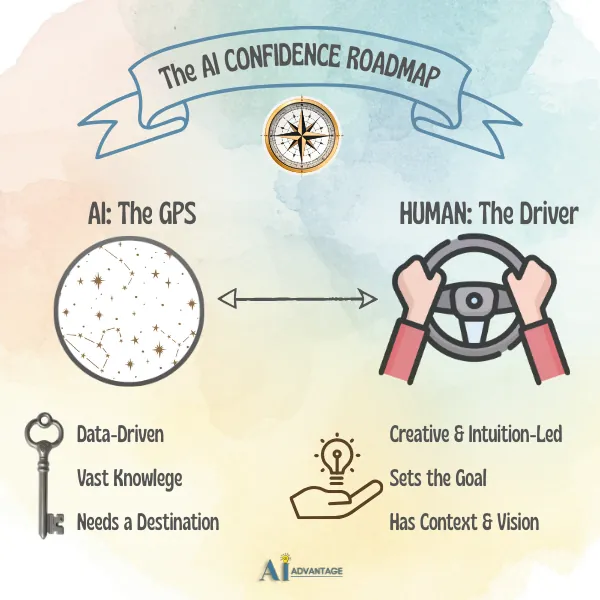
The biggest mistake we make is treating AI like a search engine. When you use Google, you want a fact. When you use AI, you are collaborating with a “hyper-intelligent newly hired personal assistant,” as I say in all my workshops.
Think about it: If you hired a human assistant today, you wouldn’t just say “write an email” and walk away. You’d tell them who you are, who the client is, and what the “vibe” of your business is. That is exactly what my BRAND framework does for your prompting.
From Generic to “Mind-Reading”
To get those “oh, I get it now!” breakthroughs, you have to move past the simple prompt. Instead of just asking for a task, try layering in these five elements:
- B — Background: Tell the AI who you are and what the project is.
- R — Role: Tell the AI exactly who it should be … like a “seasoned fundraising director” or a “social media guru.”
- A — Actions: Define the specific steps you want it to follow.
- N — Needs: Set the boundaries, like “don’t use flowery language” or “keep it under 3 sentences.”
- D — Desires: Explain the ultimate goal, such as “re-enlist our previous donors.”
When I applied this to that same follow-up email, the “robotic” tone vanished. Suddenly, my assistant knew my voice, my goals, and my constraints. It wasn’t magic, it was just good communication.
The Takeaway
Using AI isn’t a coding skill; it’s a communication skill. When you provide the right instructions, you turn a generic chatbot into a business asset that feels like it’s reading your mind.
Ready to build your own “Mind-Reading” assistant? Join us at our next EVERYDAY AI: Prompting Like a Pro workshop. It’s the first workshop in our series and it’s designed to help you master the BRAND framework hands-on. You can find the calendar right on the home page of AI ADVANTAGE.
What is one task on your to-do list that feels “too complex” to explain to a bot right now?

Carol Chenot
AI Educator & Mentor
Making AI Accessible, Understandable & Useful





Share Your Thoughts
Have a question or want to share your experience? I'd love to hear from you.